

Even as polling indicates that a majority of Trump voters don't want to go to war with Iran on behalf of Israel, it’s been difficult to change GOP minds on Capitol Hill.
But that doesn’t mean there aren’t strong conservative voices trying to do just that.
Indeed, some Republicans have come out swinging against the prospects of the U.S. joining Israel in their attacks against Iran. “This is not our war,” Rep. Thomas Massie (R-Ky) proclaimed in an X post where he invited colleagues to support his recently introduced War Powers Resolution, which would prevent the U.S. from engaging in any “hostilities” against Iran if passed. “But if it were, Congress must decide such matters according to our Constitution.”
Rep. Tim Burchett (R-Tenn.) likewise called Republicans pushing conflict with Iran “war pimps.”
“I just don’t see American boys and girls going to a faraway land that many of us couldn’t even find on a map,” Burchett told CNN’s John Berman. “We do not need a three-front war in our lifetime right now. I just don’t think that’s the route to go. There’ll be room for debate, but I think we ought to let the president do his negotiating skills. That’s what I elected him to do.”
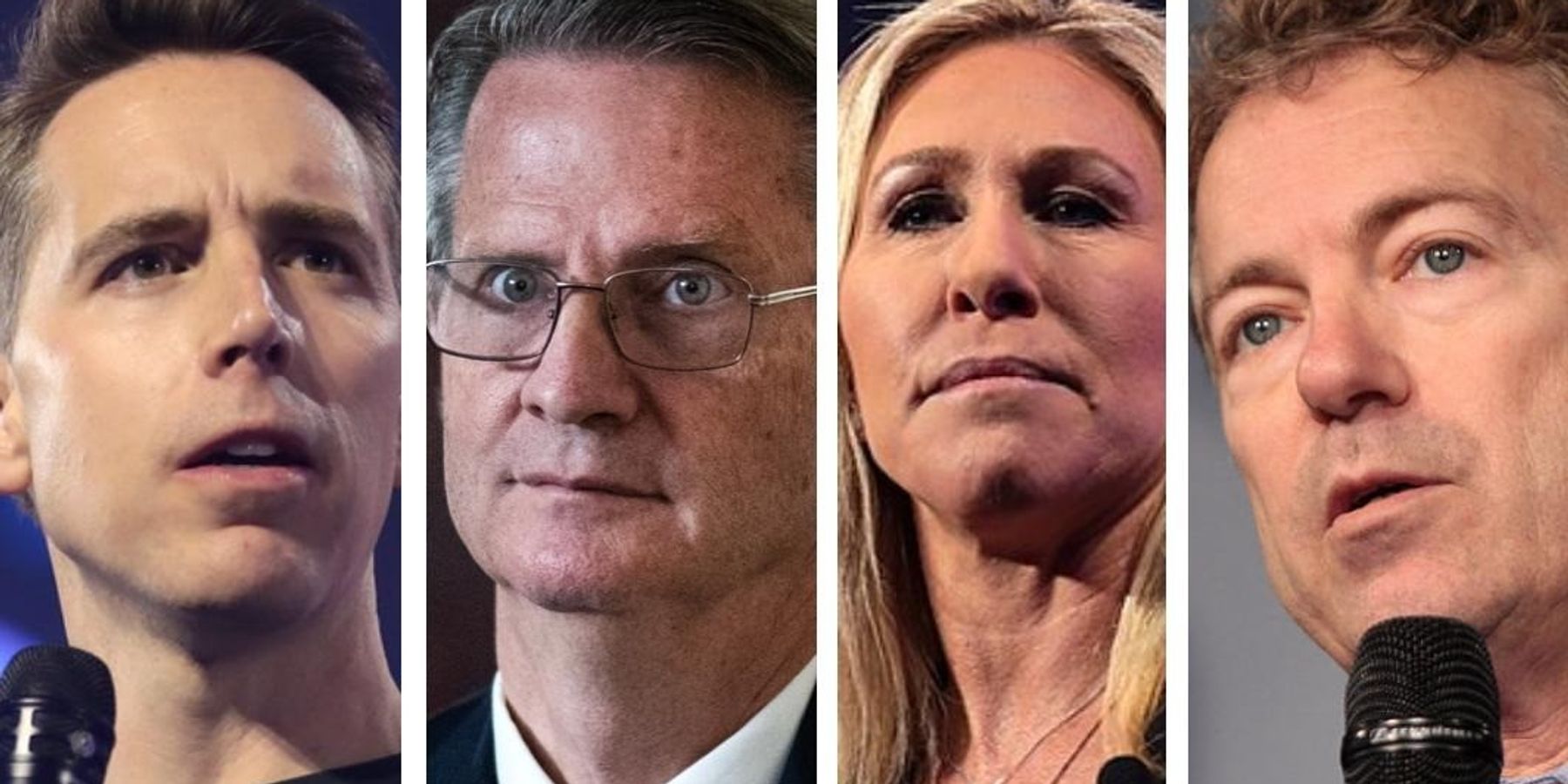
Senator Josh Hawley (R-Mo.), a vocal supporter of Israel, nonetheless also voiced concern about the U.S. getting dragged into conflict. He told Manu Raju, CNN’s Chief Congressional Correspondent, that Israel could act in its own interests. But, he explained, “it’s a very different thing for us to then say, ‘We are going to offensively, affirmatively go strike Iran or insert ourselves into the conflict.’ That to me is — that's a whole different matter…I'd be real concerned about that.”
“I don't want us fighting a war,” Hawley said. “I don't want another Mid-east war.”
Along similar lines, Sen. Rand Paul (R-Ky.) said that “it’s not the U.S.’s job to be involved” in Israel’s war with Iran on NBC’s Meet the Press.
And Rep. Marjorie Taylor Greene (R-Ga.) warned that other conservatives’ hawkishness over war with Iran could “fracture” the MAGA movement. “Americans want cheap gas, groceries, bills, and housing. They want affordable insurance, safe communities, and good education for their children. They want a government that works on these issues,” Greene wrote on X Tuesday.
“Considering Americans pay for the entire government and government salaries with their hard earned tax dollars, this is where our focus should be. Not going into another foreign war.”
But while some Republicans want to put a red light on the lurch to intervention, many others are pushing explicitly to participate in it. Sen. Kevin Cramer (R-N.D,), for example, said he would support a U.S. decision to strike Iran, or otherwise "assist Israel in getting the job done."
Iran “pledged to wipe out the United States of America. I prefer not to let them get here…I prefer preemptive prevention of war rather than having to end one after it gets to our soil, right?,” Cramer asserted.
"Either you want [Iran] to have a nuclear weapon, or you don't," Sen. Lindsey Graham (R-S.C.) told reporters this week. "And if you don't, if diplomacy fails, you use force."
Could support for war come back to bite?
Observers tell RS that lawmakers pushing for war are holding onto dated foreign policy positions — even if such positions are increasingly diverging from the conservative base.
"Most Republican officeholders have not developed a foreign-policy outlook of their own. They take their bearings from what the old-guard conservative movement used to say and from what President Trump says now," Daniel McCarthy, syndicated columnist and editor of Modern Age journal, told RS. "It was similar in 2003, when most Republicans went along with George W. Bush’s Iraq War.”
As Jim Antle, Executive Editor of The Washington Examiner, told RS: “Congressional GOP hasn't caught up [with their base]. [There are] only small numbers of populists and libertarians. Old-school moderates are almost all gone. Those are the restraint-friendly elements of the party.”
"Also Trump is the main man," he added. "If he says bomb, we bomb. If he says peace, we are flipping the peace sign."
In comments to RS, McCarthy highlighted the story of the late Republican Congressman Walter Jones, who realized later in the Iraq War his previous support of the conflict was disastrous for his constituents, a military-heavy district in North Carolina. He was politically sidelined in Congress for his dovish change of heart.
“(He) did exactly what they are doing now. He went along with the zombie-like shuffle to war; he even coined the term 'freedom fries,'" McCarthy said. “But later he was ashamed of how easily he’d been led into supporting a policy that was disastrous for the country and his district. Jones would be horrified if he were alive to see his fellow legislators making the same mistakes. They can avoid that by learning from Jones’s experience.”
Jones’ career suffered because he recanted his Iraq war support. But McCarthy supposes that Republicans who are hesitant to speak against war with Iran might do well to consider the political risks of not speaking out against it.
“Republican officeholders too often believe there’s safety in a crowd, and it’s better to be wrong in a group than to be right on your own," McCarthy said. "But the public turned against the whole party because of Bush’s wars, and anything like a repeat of them will turn the force of populism against the GOP."- MAGA influencers want an Iran deal and for hawks to shut up ›
- Poll: Nearly two-thirds of Republicans support talks with Iran ›
- The EU's pathetic response to Trump's Iran attack | Responsible Statecraft ›
- MTG moves to cut aid to 'nuclear armed' Israel | Responsible Statecraft ›
- How Ron Paul took a battering ram to GOP foreign policy | Responsible Statecraft ›